 Add to Chrome
 Add to Firefox
 Add to Edge
Learning Robust and Task-Invariant Functional Representation from fMRI through Siamese Self-Supervised Learning
May 27, 2026
Functional magnetic resonance imaging (fMRI) is a powerful tool for investigating human brain function. However, the high cost of data acquisition and the inherent subjectivity of psychiatric rating scales often lead to datasets with small sample sizes and variable label quality, especially when targeting a specific neurological condition. Combined with the inherently high dimensionality of fMRI data, these limitations substantially increase the risk of model overfitting. Recent years have seen growing interest in developing fMRI foundation models by combining multiple datasets; however, the computational resources needed for pretraining and fine-tuning are often prohibitive. We show that a lightweight self-supervised framework yields representations that generalize across diverse downstream tasks, outperforming fully supervised baselines and approaching the performance of large-scale models. We introduce BrainSimSiam, a data-efficient self-supervised representation learning framework that leverages positive-only data pairs to learn robust and generalizable features. We demonstrate that the learned representations achieve strong performance across multiple downstream classification and regression tasks, highlighting the potential of BrainSimSiam for data-limited neuroimaging applications.

FM-fMRI: Event Conditioned Flow Matching for Rest-to-Task fMRI Time-Series Synthesis
May 26, 2026Task-based fMRI provides a direct readout of task-evoked neural dynamics, but it is expensive and difficult to acquire at scale, motivating rest-to-task synthesis from widely available resting-state fMRI (rsfMRI). We propose FM-fMRI, an event-conditioned flow-matching model that learns a continuous-time conditional vector field to generate task ROI time series from a subject's rsfMRI and the task event information. The formulation enables fast ODE-based sampling and flexible conditioning over heterogeneous event schedules. Rather than optimizing for pointwise reconstruction, we evaluated generated signals using complementary criteria that probe temporal and spectral structure, subject and group-level connectome consistency, and distributional alignment. On the public Human Connectome Project and internal BioPoint autism cohort, FM-fMRI achieves the strongest spectral and connectivity agreement and improved distribution-level matching over conditional diffusion, generative adversarial networks (GANs), and variational autoencoders (VAEs) baselines. Furthermore, we augment the BioPoint cohort by synthesizing task-fMRI ROI time series with our method, improving downstream autism classification and demonstrating practical utility in data-limited clinical settings. The code will be available on GitHub.
VidDoS: Universal Denial-of-Service Attack on Video-based Large Language Models
Mar 02, 2026Video-LLMs are increasingly deployed in safety-critical applications but are vulnerable to Energy-Latency Attacks (ELAs) that exhaust computational resources. Current image-centric methods fail because temporal aggregation mechanisms dilute individual frame perturbations. Additionally, real-time demands make instance-wise optimization impractical for continuous video streams. We introduce VidDoS, which is the first universal ELA framework tailored for Video-LLMs. Our method leverages universal optimization to create instance-agnostic triggers that require no inference-time gradient calculation. We achieve this through $\textit{masked teacher forcing}$ to steer models toward expensive target sequences, combined with a $\textit{refusal penalty}$ and $\textit{early-termination suppression}$ to override conciseness priors. Testing across three mainstream Video-LLMs and three video datasets, which include video question answering and autonomous driving scenarios, shows extreme degradation. VidDoS induces a token expansion of more than 205$\times$ and inflates the inference latency by more than 15$\times$ relative to clean baselines. Simulations of real-time autonomous driving streams further reveal that this induced latency leads to critical safety violations. We urge the community to recognize and mitigate these high-hazard ELA in Video-LLMs.
CleanUpBench: Embodied Sweeping and Grasping Benchmark
Aug 07, 2025Embodied AI benchmarks have advanced navigation, manipulation, and reasoning, but most target complex humanoid agents or large-scale simulations that are far from real-world deployment. In contrast, mobile cleaning robots with dual mode capabilities, such as sweeping and grasping, are rapidly emerging as realistic and commercially viable platforms. However, no benchmark currently exists that systematically evaluates these agents in structured, multi-target cleaning tasks, revealing a critical gap between academic research and real-world applications. We introduce CleanUpBench, a reproducible and extensible benchmark for evaluating embodied agents in realistic indoor cleaning scenarios. Built on NVIDIA Isaac Sim, CleanUpBench simulates a mobile service robot equipped with a sweeping mechanism and a six-degree-of-freedom robotic arm, enabling interaction with heterogeneous objects. The benchmark includes manually designed environments and one procedurally generated layout to assess generalization, along with a comprehensive evaluation suite covering task completion, spatial efficiency, motion quality, and control performance. To support comparative studies, we provide baseline agents based on heuristic strategies and map-based planning. CleanUpBench bridges the gap between low-level skill evaluation and full-scene testing, offering a scalable testbed for grounded, embodied intelligence in everyday settings.
Not Only Consistency: Enhance Test-Time Adaptation with Spatio-temporal Inconsistency for Remote Physiological Measurement
Jul 10, 2025Remote photoplethysmography (rPPG) has emerged as a promising non-invasive method for monitoring physiological signals using the camera. Although various domain adaptation and generalization methods were proposed to promote the adaptability of deep-based rPPG models in unseen deployment environments, considerations in aspects like privacy concerns and real-time adaptation restrict their application in real-world deployment. Thus, we aim to propose a novel fully Test-Time Adaptation (TTA) strategy tailored for rPPG tasks in this work. Specifically, based on prior knowledge in physiology and our observations, we noticed not only there is spatio-temporal consistency in the frequency domain of rPPG signals, but also that inconsistency in the time domain was significant. Given this, by leveraging both consistency and inconsistency priors, we introduce an innovative expert knowledge-based self-supervised \textbf{C}onsistency-\textbf{i}n\textbf{C}onsistency-\textbf{i}ntegration (\textbf{CiCi}) framework to enhances model adaptation during inference. Besides, our approach further incorporates a gradient dynamic control mechanism to mitigate potential conflicts between priors, ensuring stable adaptation across instances. Through extensive experiments on five diverse datasets under the TTA protocol, our method consistently outperforms existing techniques, presenting state-of-the-art performance in real-time self-supervised adaptation without accessing source data. The code will be released later.
Sage Deer: A Super-Aligned Driving Generalist Is Your Copilot
May 15, 2025The intelligent driving cockpit, an important part of intelligent driving, needs to match different users' comfort, interaction, and safety needs. This paper aims to build a Super-Aligned and GEneralist DRiving agent, SAGE DeeR. Sage Deer achieves three highlights: (1) Super alignment: It achieves different reactions according to different people's preferences and biases. (2) Generalist: It can understand the multi-view and multi-mode inputs to reason the user's physiological indicators, facial emotions, hand movements, body movements, driving scenarios, and behavioral decisions. (3) Self-Eliciting: It can elicit implicit thought chains in the language space to further increase generalist and super-aligned abilities. Besides, we collected multiple data sets and built a large-scale benchmark. This benchmark measures the deer's perceptual decision-making ability and the super alignment's accuracy.
Causal Modeling of fMRI Time-series for Interpretable Autism Spectrum Disorder Classification
Feb 21, 2025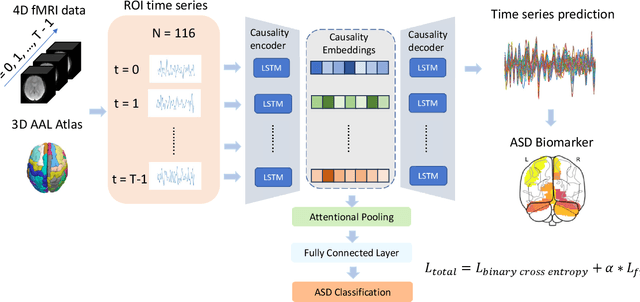
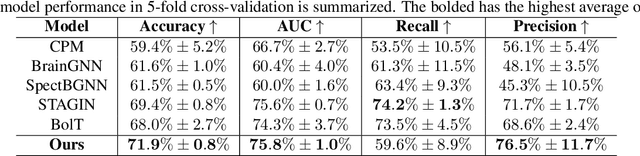
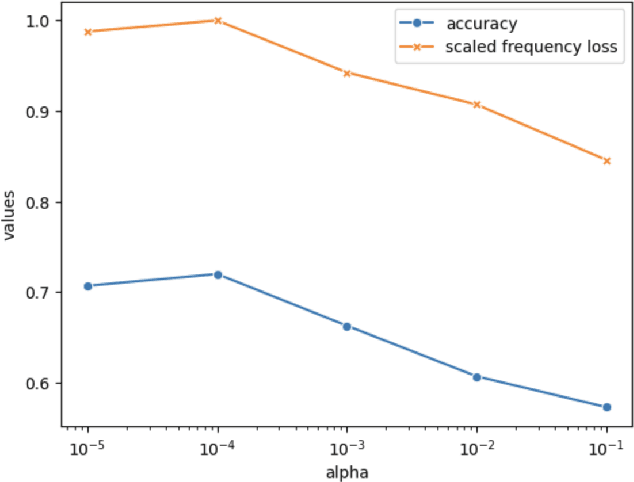
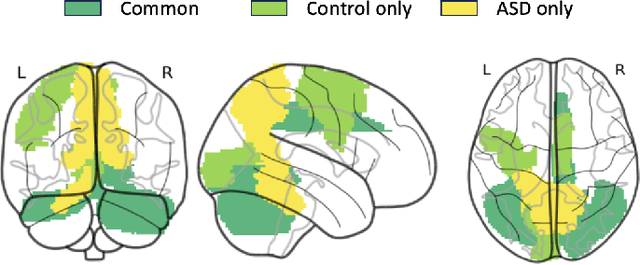
Autism spectrum disorder (ASD) is a neurological and developmental disorder that affects social and communicative behaviors. It emerges in early life and is generally associated with lifelong disabilities. Thus, accurate and early diagnosis could facilitate treatment outcomes for those with ASD. Functional magnetic resonance imaging (fMRI) is a useful tool that measures changes in brain signaling to facilitate our understanding of ASD. Much effort is being made to identify ASD biomarkers using various connectome-based machine learning and deep learning classifiers. However, correlation-based models cannot capture the non-linear interactions between brain regions. To solve this problem, we introduce a causality-inspired deep learning model that uses time-series information from fMRI and captures causality among ROIs useful for ASD classification. The model is compared with other baseline and state-of-the-art models with 5-fold cross-validation on the ABIDE dataset. We filtered the dataset by choosing all the images with mean FD less than 15mm to ensure data quality. Our proposed model achieved the highest average classification accuracy of 71.9% and an average AUC of 75.8%. Moreover, the inter-ROI causality interpretation of the model suggests that the left precuneus, right precuneus, and cerebellum are placed in the top 10 ROIs in inter-ROI causality among the ASD population. In contrast, these ROIs are not ranked in the top 10 in the control population. We have validated our findings with the literature and found that abnormalities in these ROIs are often associated with ASD.
STAHGNet: Modeling Hybrid-grained Heterogenous Dependency Efficiently for Traffic Prediction
Dec 23, 2024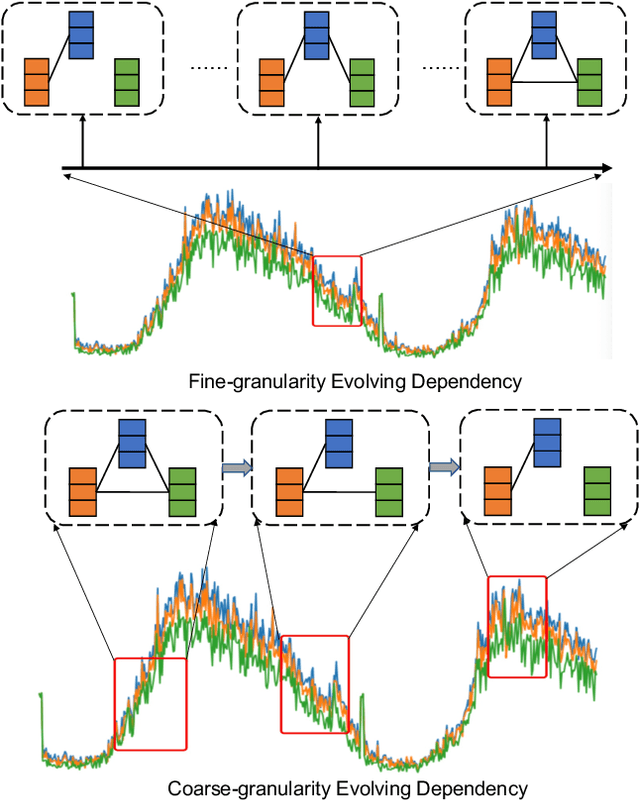
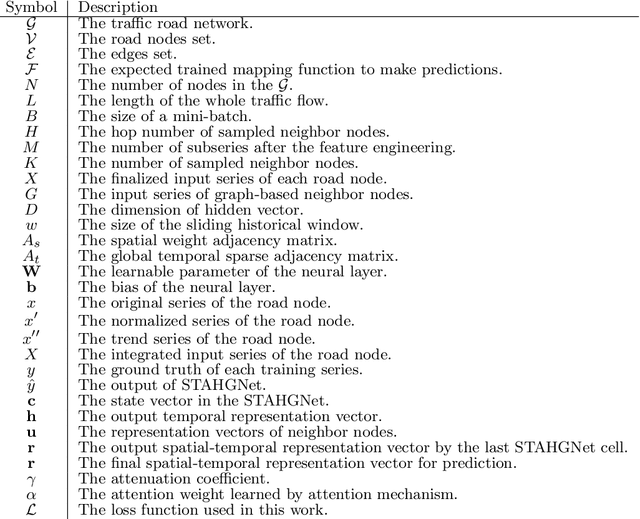
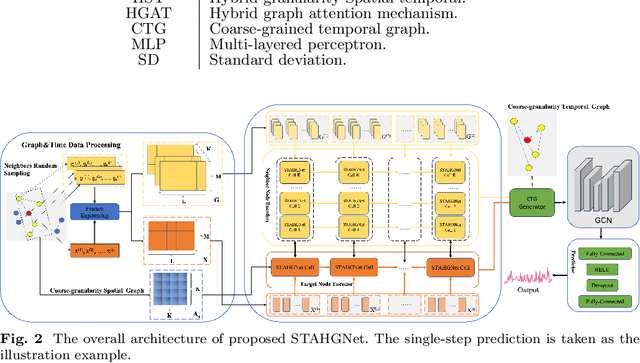
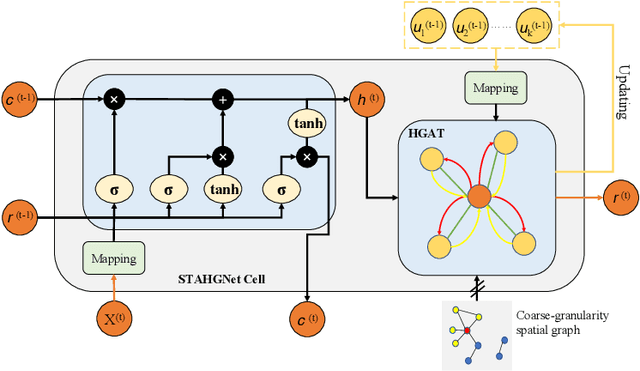
Traffic flow prediction plays a critical role in the intelligent transportation system, and it is also a challenging task because of the underlying complex Spatio-temporal patterns and heterogeneities evolving across time. However, most present works mostly concentrate on solely capturing Spatial-temporal dependency or extracting implicit similarity graphs, but the hybrid-granularity evolution is ignored in their modeling process. In this paper, we proposed a novel data-driven end-to-end framework, named Spatio-Temporal Aware Hybrid Graph Network (STAHGNet), to couple the hybrid-grained heterogeneous correlations in series simultaneously through an elaborately Hybrid Graph Attention Module (HGAT) and Coarse-granularity Temporal Graph (CTG) generator. Furthermore, an automotive feature engineering with domain knowledge and a random neighbor sampling strategy is utilized to improve efficiency and reduce computational complexity. The MAE, RMSE, and MAPE are used for evaluation metrics. Tested on four real-life datasets, our proposal outperforms eight classical baselines and four state-of-the-art (SOTA) methods (e.g., MAE 14.82 on PeMSD3; MAE 18.92 on PeMSD4). Besides, extensive experiments and visualizations verify the effectiveness of each component in STAHGNet. In terms of computational cost, STAHGNet saves at least four times the space compared to the previous SOTA models. The proposed model will be beneficial for more efficient TFP as well as intelligent transport system construction.
Efficient Mixture-of-Expert for Video-based Driver State and Physiological Multi-task Estimation in Conditional Autonomous Driving
Oct 28, 2024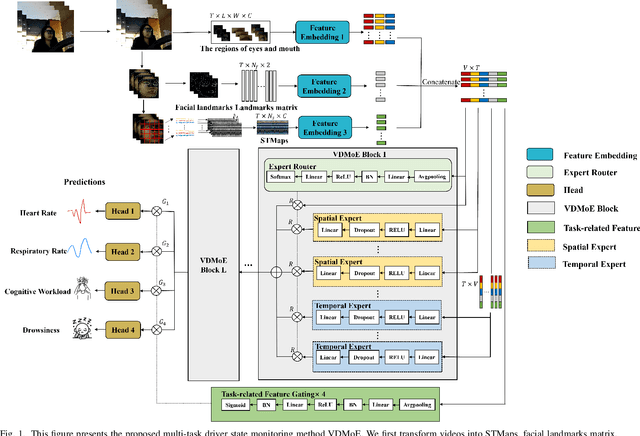
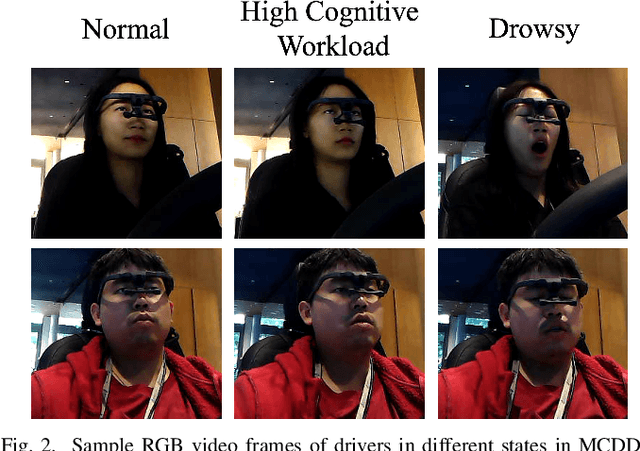
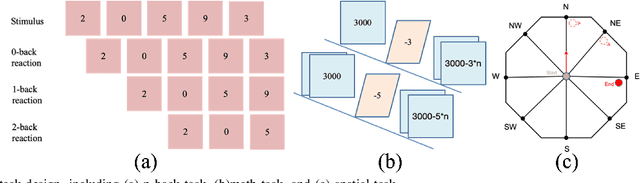
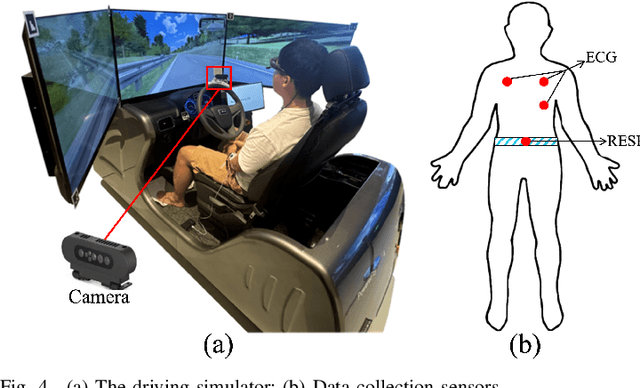
Road safety remains a critical challenge worldwide, with approximately 1.35 million fatalities annually attributed to traffic accidents, often due to human errors. As we advance towards higher levels of vehicle automation, challenges still exist, as driving with automation can cognitively over-demand drivers if they engage in non-driving-related tasks (NDRTs), or lead to drowsiness if driving was the sole task. This calls for the urgent need for an effective Driver Monitoring System (DMS) that can evaluate cognitive load and drowsiness in SAE Level-2/3 autonomous driving contexts. In this study, we propose a novel multi-task DMS, termed VDMoE, which leverages RGB video input to monitor driver states non-invasively. By utilizing key facial features to minimize computational load and integrating remote Photoplethysmography (rPPG) for physiological insights, our approach enhances detection accuracy while maintaining efficiency. Additionally, we optimize the Mixture-of-Experts (MoE) framework to accommodate multi-modal inputs and improve performance across different tasks. A novel prior-inclusive regularization method is introduced to align model outputs with statistical priors, thus accelerating convergence and mitigating overfitting risks. We validate our method with the creation of a new dataset (MCDD), which comprises RGB video and physiological indicators from 42 participants, and two public datasets. Our findings demonstrate the effectiveness of VDMoE in monitoring driver states, contributing to safer autonomous driving systems. The code and data will be released.
STNAGNN: Spatiotemporal Node Attention Graph Neural Network for Task-based fMRI Analysis
Jun 17, 2024Task-based fMRI uses actions or stimuli to trigger task-specific brain responses and measures them using BOLD contrast. Despite the significant task-induced spatiotemporal brain activation fluctuations, most studies on task-based fMRI ignore the task context information aligned with fMRI and consider task-based fMRI a coherent sequence. In this paper, we show that using the task structures as data-driven guidance is effective for spatiotemporal analysis. We propose STNAGNN, a GNN-based spatiotemporal architecture, and validate its performance in an autism classification task. The trained model is also interpreted for identifying autism-related spatiotemporal brain biomarkers.